
A Wikipedia edit changed Leon Schreiber’s nationality just 12 minutes after president Cyril Ramaphosa’s unity cabinet appointments were due to be announced. For the previous four years, the page had correctly put the new Home Affairs minister’s birthplace in South Africa.
MARY ALEXANDER • 3 July 2024
In a “family meeting” on the evening of 30 June 2024, South African president Cyril Ramaphosa announced his expanded cabinet in the country’s new government of national unity.
Ramaphosa’s African National Congress (ANC) lost its 30-year parliamentary majority in elections held on 29 May. The ANC got just 40.2% of the national vote, with 21.8% going to the main opposition Democratic Alliance (DA) and 14.6% to the newcomer uMkhonto weSizwe Party.
With no majority, the parties negotiated a unity government. This included giving some cabinet positions to members of opposition parties. South Africa’s cabinet is made up of ministers and deputy ministers of national departments.
The DA’s Leon Schreiber was appointed minister of home affairs. The department maintains South Africa’s population register, issues IDs and passports, and handles immigration – including the status of refugees and asylum seekers.
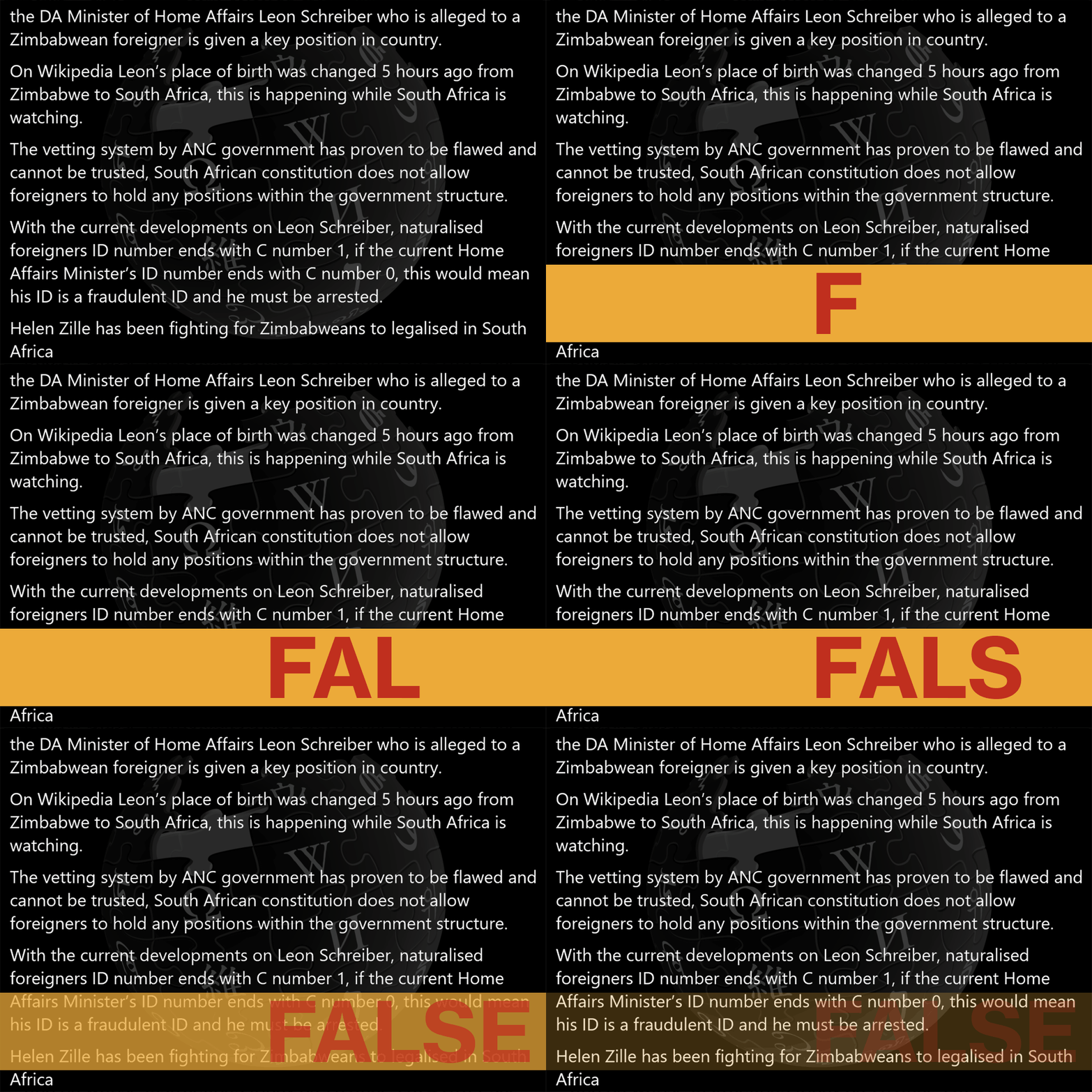
Soon after Ramaphosa’s cabinet announcement, a viral claim that Schreiber was “a Zimbabwean foreigner” appeared on social media.*
It reads:
The Republic of South Africa demands answers as the DA Minister of Home Affairs Leon Schreiber who is alleged to a Zimbabwean foreigner is given a key position in country. On Wikipedia Leon’s place of birth was changed 5 hours ago from Zimbabwe to South Africa, this is happening while South Africa is watching.
Migration into South Africa – particularly the migration of people from elsewhere on the continent – was a major issue in the 2024 elections. The anti-migrant social movement Operation Dudula went so far as to attempt to register as a political party before the polls.
People from Zimbabwe and Mozambique, two of South Africa’s closest neighbours, are often targets of this xenophobia.
Schreiber’s place of birth was recently changed on his Wikipedia page. But that’s no proof he’s “a Zimbabwean foreigner”. Instead, it points to disinformation.
Wikipedia tracks all changes
Wikipedia is a free and open-source encyclopaedia maintained by volunteers across the internet. Anyone can edit a Wikipedia page, although others may quickly revert – change back – the edits if they disagree.
But every single published change to any Wikipedia page is saved, with its own online address, in the page’s history.
Using the revision history tab on Schreiber’s Wikipedia page, we found that it was first created on 21 April 2020. The original sidebar summary says he was born in “Namaqualand, Cape Province, South Africa” in 1988.
In 1996 the old Cape province was divided into the Northern Cape, Eastern Cape, Western Cape and the western part of North West. Today, the broad Namaqualand region extends southwards from Namibia into South Africa’s Northern and Western Cape.
Schreiber’s place of birth remained unchanged on Wikipedia for more than four years. Then came the evening of Ramaphosa’s cabinet appointments.
Although delayed on public TV, the appointments were released at 21:00 on 30 June. Twelve minutes later, at 21:12, an unnamed Wikipedia user changed Schreiber’s birthplace from Namaqualand to “Borrowdale, Harare Zimbabwe”.
Borrowdale is a wealthy suburb in Harare, Zimbabwe’s capital.
A Wikipedia “edit war” soon followed, with users reverting the change, others putting it back, and so on. At one point Schreiber’s nationality was changed from “South African” to “Zimbabwean]]on”.
The page was eventually protected from arbitrary editing in the afternoon of 1 July. The current page (as of 3 July) says Schreiber was born in “Piketberg, Cape Province”. Piketberg in the Western Cape is part of the Namaqualand region.
All of Schreiber’s other online biographies put his birthplace in Namaqualand, South Africa. There is no evidence that South Africa’s new home affairs minister was born in Harare or is “a Zimbabwean foreigner”.
Wikipedia is an invaluable source of information. But it can be abused to create disinformation.
* Some Facebook and Instagram users may have deleted their posts after Meta’s Third-Party Fact-Checking Program rated their claims as untrue.
Published by Africa Check on 4 July 2024
Categories: Fact checks


You must be logged in to post a comment.