
Nelson Mandela’s family tree
Nelson Mandela was born in 1918 and died, aged 95, in 2013. His family tree remains, growing from three wives and six children to 17 grandchildren, 19 great-grandchildren and on …
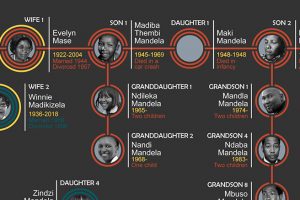
Nelson Mandela was born in 1918 and died, aged 95, in 2013. His family tree remains, growing from three wives and six children to 17 grandchildren, 19 great-grandchildren and on …

South Africa is home to 63 million people. About 81.7% of them are black, 8.5% coloured, 2.6% Indian/Asian and 7.2% white. Find out more about birth, death, age, HIV, migration and other population trends.
It protects everyone in the country – not just citizens. The Bill of Rights safeguards the democratic values of dignity, equality and freedom, and demands that basic needs are met.

Where are South Africa’s poorest places? Two maps find the patterns of poverty: one shows the share of households living in poverty in each municipality, the other the number of poor people living there. And an animation tries to make sense of the maps.

Nelson Mandela and Oliver Tambo were friends for 60 years, from student days to partnership in a law firm, through imprisonment and exile, until the final victory over apartheid.

They have found important fossils in the human family. They have no degrees but instruct visiting researchers. Now the fossil technicians of the Sterkfontein Caves may get the recognition they deserve.

Mixed with over a dozen African languages for over two centuries, spiced by imports from British, Dutch and Portuguese colonies, South African English has its own rich, varied and sometimes weird flavour.

Robert Sobukwe was one of South Africa’s greatest but forgotten heroes of the struggle for human rights and nonracialism.
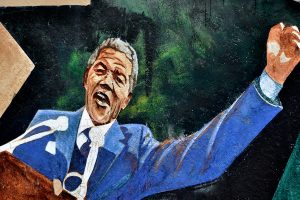
A comprehensive timeline of the life of Nelson Rolihlahla Mandela – revolutionary, soldier, political prisoner, president of South Africa, statesman and global icon of social justice.
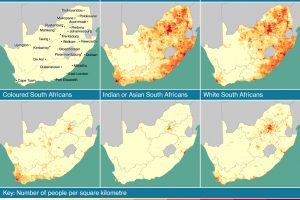
The distribution of South Africa’s population groups reveals the country’s history. Find out more with these maps of where black, coloured, Indian and white South Africans live today, according to the 2011 census.

Charting South Africans’ life expectancy is to track the country’s modern history. In 1960, when the state was grimly implementing apartheid laws, an average newborn child was expected to have a lifespan of only 52 years – 50 years for boys. In 2015, life expectancy was 62 years.

This is an animation to break your heart. In any unequal society, the privileged live long lives and everyone else much shorter lives.
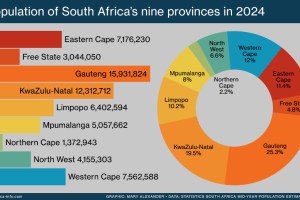
The population of each of South Africa’s nine provinces varies enormously. According to Statistics South Africa’s 2024 population estimates, the most populous provinces are Gauteng and KwaZulu-Natal, and the emptiest the Northern Cape and Free State.
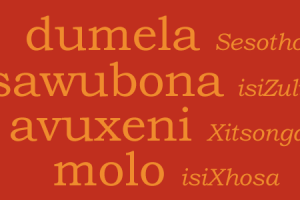
Each of South Africa’s 11 languages has a fascinating vocabulary, with some words and phrases influenced by other languages, and many unique to that language.
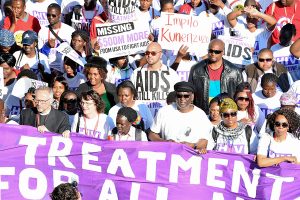
South Africa’s story of HIV and Aids starts with tragic arrogance in a new democracy suddenly threatened from an unexpected direction. Then came activism and tenacity by ordinary citizens. Today, the country has one of the world’s biggest treatment programmes.
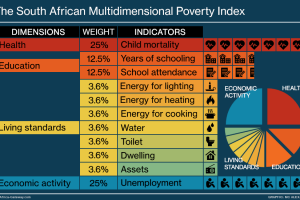
The South African Multidimensional Poverty Index looks at how poverty reveals itself in people’s health, their level of education, the dwelling they live in, how they cook their food, the water they drink …
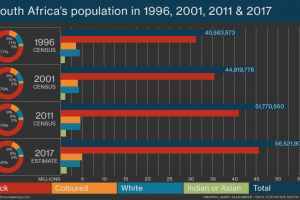
South Africa has held three official censuses in its recent democratic history: in 1996, 2001 and 2011. The censuses have revealed both a growing population – from 41 million to 52 million – and a significant shift in the country’s racial profile.
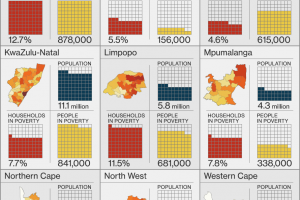
The Eastern Cape is South Africa’s poorest province, both in its percentage of poor households and the number of its people who live in poverty. The province with the smallest share of households in poverty is the Western Cape.
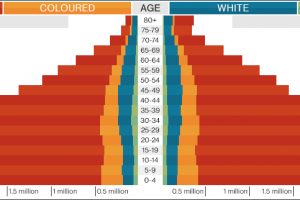
Black men have the shortest lives, and white women the longest. Find out more about the country’s population structure with this infographic charting the realities of age, race and sex in South Africa.
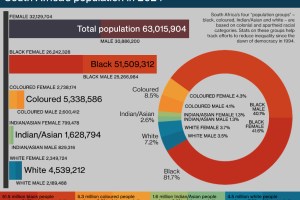
In 2024 South Africa had a population of 63 million. Black people were the majority at 51.5 million – 81.7% of the total. There were 5.3 million coloured people (8.5%), 4.5-million white people (7.2%) and 1.6-million Indian/Asian people (2.6%).


You must be logged in to post a comment.