
The false claim that “tonight” the Earth will “face its highest radiation” has been circulating online for well over a decade. It’s been given new life by the April 2024 total solar eclipse over Mexico, the US and Canada.
MARY ALEXANDER • 21 April 2024
Published by Africa Check on 25 April 2024
The April 2024 total solar eclipse over North America has sparked many myths, false claims and conspiracy theories.
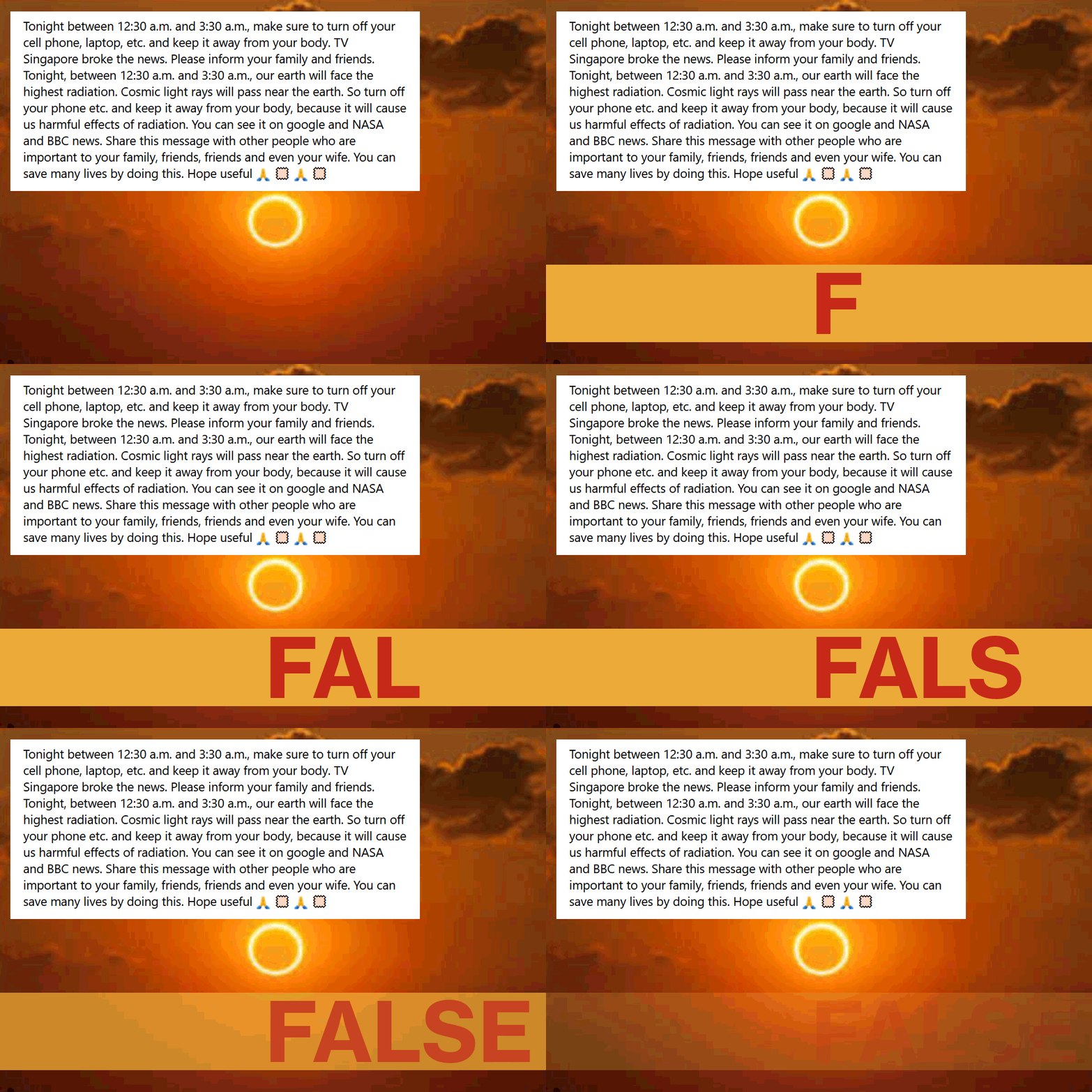
One is a warning that, “tonight”, “cosmic light rays” will “pass near” Earth, causing us “harmful effects of radiation”.*
A total solar eclipse happens when the moon, in its orbit around our planet, briefly covers the entire face of the sun. This cuts off sunlight, turning day to night.
The complex interplay of Earth’s rotation, the moon’s orbit around Earth, and the orbit of the two around the sun means total solar eclipses are rare and only occur over small parts of the planet. The highly anticipated 8 April eclipse was only seen in a tight diagonal across parts of Canada, Mexico and the contiguous United States.
This video explains more:
The “cosmic light rays” warning appeared on social media in several African countries – including Nigeria, Liberia, Rwanda, Sudan and South Sudan – in early April, with a peak just before, during and after the day of the North American eclipse.
It’s long and repetitive, but these are the basics:
Tonight between 12:30 a.m. and 3:30 a.m. … turn off your cell phone, laptop, etc. and keep it away from your body … our earth will face the highest radiation. Cosmic light rays will pass near the earth … it will cause us harmful effects of radiation. You can see it on google and NASA and BBC news.
Nasa is the US National Aeronautics and Space Administration and the BBC is the British Broadcasting Corporation.
The warning adds: “Share this message with other people who are important to your family, friends, friends and even your wife.”
Many instances of the warning associate it with the 2024 solar eclipse, with comments such as “thankfully not in Africa” and “Only In The Parts Of North America Bruh”.
It spread widely in Sudan and South Sudan. On 8 April, the day of the eclipse, it was posted on AKOKA TV, a Facebook page based in Juba, South Sudan’s capital. The post includes four photos of a solar eclipse.
But the warning is old, and false. Here’s why.
Understanding cosmic radiation
First, there’s no such scientific term as “cosmic light rays”. Cosmic rays, instead, is an old term coined in 1925 for what’s now more commonly known as cosmic radiation. And it doesn’t just “pass near” Earth. It washes over the planet all the time.
But it’s not the radiation we associate with nuclear power. Radiation exists in many forms and is an everyday thing. Our radios and microwave ovens, for example, are powered by radiation.
Cosmic radiation comes from stars, as atoms violently ejected from a star are stripped to their subatomic particles and hurtled into space.
Some of the cosmic rays that hit Earth are from collapsed stars known as black holes and the old explosions of other stars, all many trillions and quadrillions of kilometres away.
But most of it comes from the sun, our closest star. Cosmic radiation from the sun has also been called the solar wind, which causes the northern and southern lights. These stunning swirls of colour in the sky – the aurora borealis in the far northern hemisphere and the aurora australis in the far south – show the solar wind interacting with Earth’s magnetic field.
And that’s key. Earth has a strong magnetic field – a magnetosphere – created by its rotating molten iron core. Mars and Venus, Earth’s neighbours in the solar system and planets made of the same rocky stuff, don’t have a strong magnetosphere. And no life has been detected on them.
Earth’s magnetosphere, as well as its atmosphere – the thick layer of gas that covers the planet – protects us from cosmic radiation. Life here has flourished for billions of years, all the time swept by cosmic rays.
In fact, the regions of Earth under the moon’s shadow during a total solar eclipse get a vastly reduced amount of cosmic radiation.
Africa Check could find no warning by Nasa or the BBC that “cosmic light rays” were about the “pass near” Earth.
‘Zombie’ claim that just won’t die
Different versions of the claim have been circulating online since at least January 2010 – more than 14 years ago.
At the time, the claim was that the cosmic rays would be coming from Mars. Here’s an example:
Tonight btw 12.30 – 0300am cosmic rays entering earth from mars. So all r advised to put off cellphones courtesy NASA BBC news. Its causes cancer…(if u believe dat switch ur phone off, if u dont ..keep it movin..u dig?)
Mars is a planet, not a star. It doesn’t emit cosmic radiation.
In June 2023 Africa Check fact-checked a similar claim, that “Today around 12am to 3am Cosmic rays will pass near earth so make sure you switch off your phones nd put it far away from you guys its dangerous it might hurt youtell others.”
It’s just one example of a “zombie” claim that, despite repeated debunks, just won’t die.
Then, as now, the claim is false.
* Some claims posted on Facebook and Instagram may have been deleted by users after being rated via Meta’s Third-Party Fact-Checking Program.
Categories: Fact checks


You must be logged in to post a comment.