


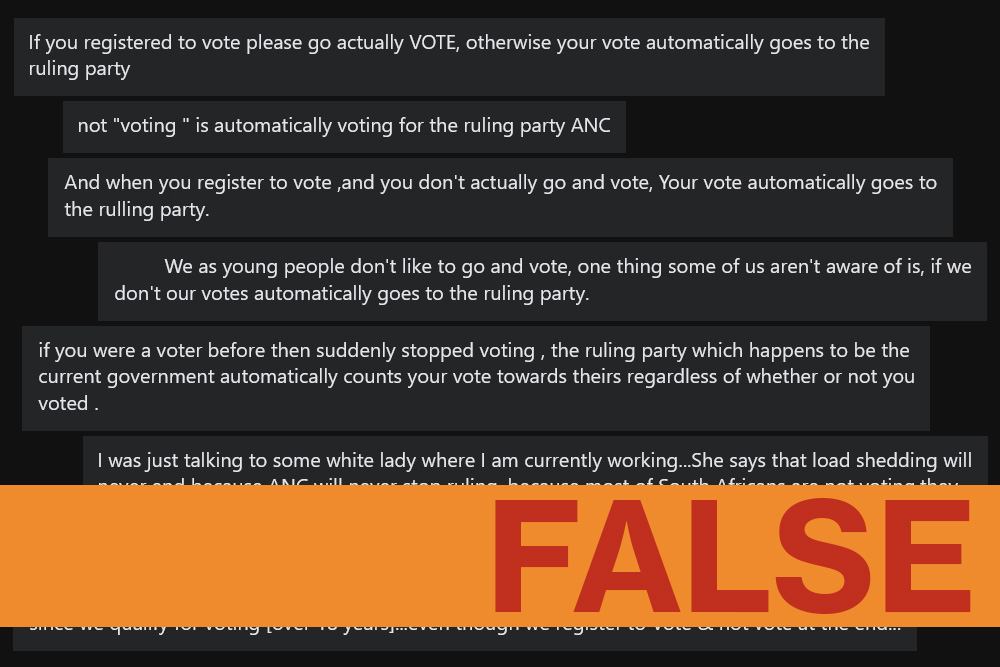
A old online rumour that if a registered voter doesn’t turn up at the polls their vote “automatically” goes to the ruling ANC has resurfaced in another election year. But while a good voter turnout makes a better democracy, no democracy works that way.
MARY ALEXANDER • 5 MARCH 2024
South Africans are set to vote on 29 May 2024 in what could be the country’s most game-changing elections in 30 years. Polls suggest the ruling African National Congress (ANC) may lose the majority it has held since 1994.
As campaign fever rises, an old rumour has surfaced on social media.*
It claims that if a voter doesn’t cast their ballot, that vote automatically goes to the ANC – or, more generally, the “ruling party”.
The rumour has many versions, all with the same basic claim:
- If you were a voter before then suddenly stopped voting , the ruling party which happens to be the current government automatically counts your vote towards theirs regardless of whether or not you voted. this is somehow one of their corrupt tendencies/system which is why people are encouraged to vote.
- I am also here to remind you that if you do not vote, your vote automatically goes to the ruling party which is ANC.
- We as young people don’t like to go and vote, one thing some of us aren’t aware of is, if we don’t our votes automatically goes to the ruling party.
- In case you didn’t know (I also didn’t know and it took me a while to grasp it), if you’re registered to vote but you do NOT vote, apparently that vote automatically goes to the ruling party.. just saying!
- Even if you are registered to vote, if you decide not to vote on the elections day, your vote will automatically fall under ANC. Simply because ANC is the ruling party.
Elections for South Africa’s national parliament and nine provincial governments are held every five years. The previous elections in 2019 saw support for the ANC drop to 57.5% of the national vote, its lowest outcome yet.
The main opposition parties are the Democratic Alliance, which won 20.8% of the vote in 2019, and the Economic Freedom Fighters, which scored 10.8%.
All South African citizens aged 18 and over are eligible to vote. But they first have to register with the Independent Electoral Commission (IEC), which adds their details to the voter’s roll.
The claim that votes not cast in the 2024 elections will “automatically” go to the ruling party can also be seen here, here, here, here, here, here and here. But is it true?
‘Why would they bother if we vote or not?’
South Africa’s Electoral Act of 1998 sets out how votes are counted in elections. There’s no mention in the act or any of its amendments that if a registered voter doesn’t vote, that vote automatically goes to the ruling party.
The IEC keeps an online database of election statistics going back to 1994. One of those stats is voter turnout, or the number of registered voters who actually turned up at the polls on election day.
In 2019 voter turnout was 66.05%. This means that out of 26,756,649 registered voters, 17,672,851 cast their vote (including 235,472 spoiled ballots). It also means that 9,083,798 voters did not vote.
These 9 million non-votes did not “go to” the ANC.
The ruling party received 10,026,475 votes, or 57.5% of all valid votes (excluding spoiled ballots), giving it 230 of the 400 seats in parliament.
If the 9 million non-voting ballots were then credited to the ANC its share would have risen to an impossible 109.59% of all valid votes. And if its total was made up of those 9 million non-votes then only 5.4% of valid votes were actually cast for the ANC – highly unlikely, given the former liberation movement’s continued (if waning) popularity.
‘There is absolutely no truth to the rumour’ – electoral commission
Some social media users make a good argument against the claim.
“If it’s true why would they [the ANC] even bother if we vote or not, because us not voting would automatically make sure that they remain in power right? So why would they encourage us?”
In other words, if the claim were true it would be in the ANC’s interest if voters stayed away from the polls. Yet the party campaigns actively and has urged people to go out and vote.
The rumour is more than a decade old, doing the rounds on social media since at least South Africa’s 2011 municipal elections. It cropped up again during national elections in 2014 (here and here) and 2019 (here and here).
In 2019 it caught the attention of the IEC, which took to X (then Twitter) to debunk it.
“There is absolutely no truth to the rumour that if you don’t vote your vote will go to the ruling (or any other) party,” the commission tweeted. “Only valid votes cast in an election are counted in the result. Thanks for checking.”
There is absolutely no truth to the rumour that if you don’t vote your vote will go to the ruling (or any other) party. Only valid votes cast in an election are counted in the result. Thanks for checking.
— IEC South Africa (@IECSouthAfrica) May 8, 2019
It’s not true that if you don’t vote, your vote automatically goes to the ruling party.
The rumour may come from an argument that people who choose not to vote – for whatever reason – somehow benefit the ruling party. But even that argument has holes in it. There is no saying which party stayaway voters would have voted for if they had cast their ballots.
* Some Facebook and Instagram users may have deleted their posts after Meta’s Third-Party Fact-Checking Program rated their claims as untrue.
Published by Africa Check on 8 March 2024